Media Figure Dr. Magdi Kamel El-Hewary Writes: Why Is Iran’s Sky Wide Open, Allowing Israeli and American Aircraft to Strike at Will? Where Have the Iranian Air Force and Air Defense Systems Gone?

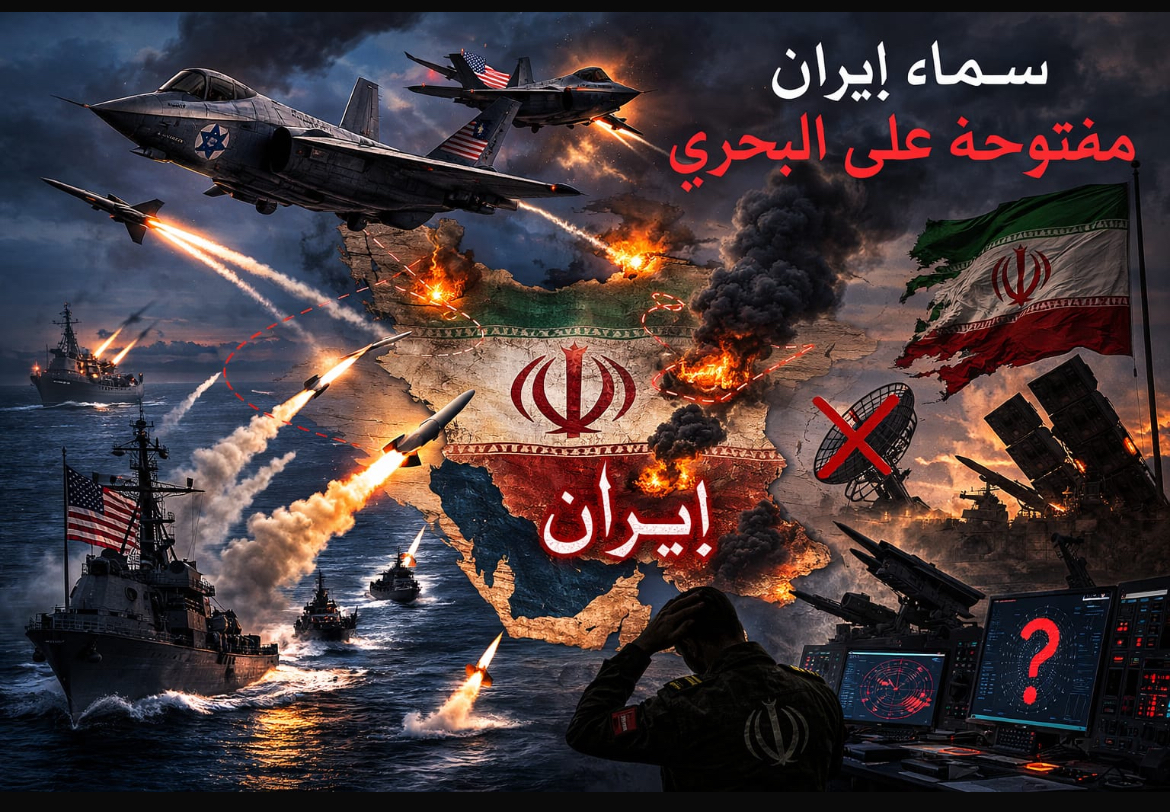
Media Figure Dr. Magdi Kamel El-Hewary Writes:
Why Is Iran’s Sky Wide Open, Allowing Israeli and American Aircraft to Strike at Will?
Where Have the Iranian Air Force and Air Defense Systems Gone?
When the sky is opened… every question opens with it.
How can a country the size of Iran — one that spends billions on armament and takes pride in its defensive systems — appear as though its airspace is exposed?
How do Israeli and American aircraft, or sea-launched missiles, reach deep into Iranian territory without decisive deterrence capable of restoring the lines of prestige?
First: Technological Superiority… The Invisible Gap
Modern wars are no longer aircraft-versus-aircraft battles.
Today we are talking about:
Stealth fighters invisible to conventional radar
Low-altitude cruise missiles
Long-range unmanned aerial systems
Electronic warfare that blinds defenses before bombardment begins
Fighter jets such as the F-35 Lightning II, operated by the air forces of Israel and the United States, were specifically designed to penetrate the most sophisticated air defense networks.
When an aircraft enters airspace and remains undetected until the final moments, the response becomes an attempt to contain damage — not to prevent the strike.
Second: The Iranian Air Force… A Legacy Force in a Modern Battlefield
Iran’s Air Force relies heavily on aircraft dating back to the pre-1979 revolution era, most notably the F-14 Tomcat, alongside locally upgraded models.
However, domestic upgrades cannot fully bridge a technological gap shaped by four decades of Western military advancement.
A modern combat aircraft is no longer merely an airframe and engine. It is an integrated information network — satellites, early warning systems, real-time command and control capabilities.
And here, the true gap emerges.
Third: Air Defense… Owning the System Is Not the Same as Controlling the Sky
Iran possesses Russian-made systems such as the S-300, in addition to domestically produced platforms.
But the critical question remains:
Are these systems fully integrated into an advanced radar network capable of detecting stealth targets and low-flying cruise missiles?
Effective air defense requires:
Long-range early warning capabilities
Multi-layered coverage
Protection against electronic jamming
Continuous operational readiness
A vulnerability in just one layer can create an “open corridor” in the sky.
Fourth: War Begins Before the Explosion Is Heard
Cyber warfare and electronic disruption cannot be overlooked.
Before aircraft take off, networks may already be disabled.
Before missiles are launched, radar systems may already be blinded.
Modern warfare begins by switching off the screens… and only then does the bombardment follow.
Fifth: Deterrence Calculations… Silence Can Be Strategic
The scene may appear as though the sky is open without resistance. Yet politics often restrains the military trigger.
An immediate response could ignite a full-scale regional war — in a region where major powers such as Russia and China stand along sensitive fault lines.
At times, states opt for indirect retaliation or delayed response, preserving balances more complex than what is visible on the surface.
The Most Critical Question
Where has the Iranian Air Force gone?
Is it absent… or constrained?
Is air defense incapable… or electronically targeted?
Or has the real battle yet to begin?
In the modern balance of power, whoever controls the sky controls the initiative.
And any sky tested today… may be reshaped tomorrow by greater fire.
The question remains open:
Are we witnessing weakness in capability — or calculated restraint in the era of undeclared wars?
✍️
Dr. Magdi Kamel El-Hewary