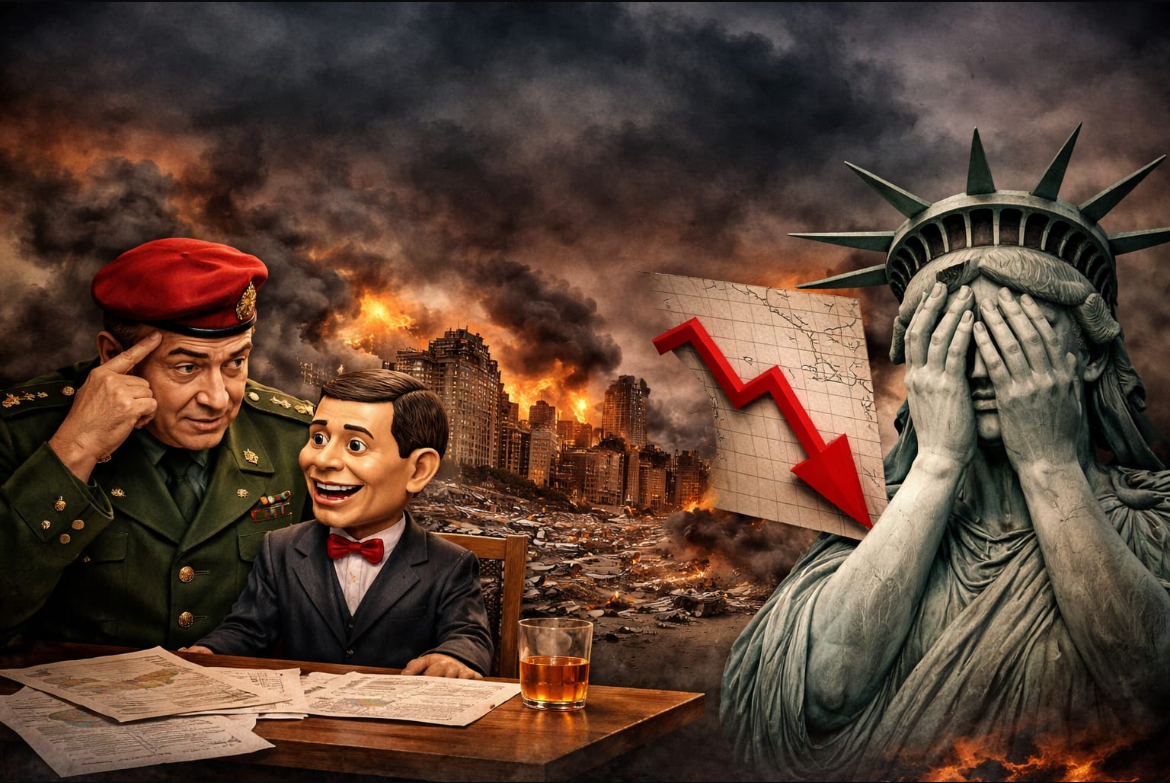
In a world governed by calculated strategies and rational decision-making, “political stupidity” stands as one of the most dangerous factors capable of toppling regimes, dismantling societies, and pushing entire nations into an uncertain and often dark future.
Political stupidity does not merely mean a lack of intelligence; it reflects poor judgment, absence of strategic vision, stubborn decision-making, and the tendency to handle crises with short-term reactions rather than long-term statecraft.
Politics is not a game of slogans—it is the art of managing interests. When political decisions are driven by emotions or narrow personal agendas, the state turns into a testing ground, and the people inevitably become the victims.
First: When Stubbornness Turns into Disaster – The Case of Iraq
One of the clearest examples of political miscalculation in modern history is Iraq prior to 2003.
Continuous escalation with global powers, refusal to offer calculated compromises, and engagement in unequal confrontations ultimately led to a full-scale invasion, the collapse of the state, and the dismantling of its institutions.
The mistake was not merely in confrontation, but in the failure to accurately assess the global balance of power, and the illusion that rhetoric alone could stand against international military coalitions.
The result? A nation that continues to suffer from the consequences of those decisions to this day.
Second: Illusions of Power – Nazi Germany
In the 1930s, German leadership drove the country into World War II under ambitions of expansion and dominance.
Despite early victories, the uncalculated expansion and the opening of multiple fronts simultaneously proved to be a catastrophic political decision.
The leadership believed it could dominate Europe entirely, while ignoring time, economic capacity, and the strength of opposing alliances.
The outcome was total destruction, the division of the state, and millions of casualties.
Third: Ignoring the People – The Arab Spring
In several Arab countries, political misjudgment was evident in the prolonged neglect of public demands.
Relying solely on security measures without meaningful political or economic reform created explosive situations.
In some countries, regimes fell within days; in others, the situation escalated into prolonged civil conflicts that continue to this day.
The mistake was not in the protests themselves, but in failing to address them before they evolved into full-scale revolutions.
Fourth: Poor Economic Decisions – The Case of Venezuela
Venezuela once possessed one of the largest oil reserves in the world, yet it became a textbook example of severe economic collapse.
Uncalculated economic policies, overdependence on a single resource, and impulsive political decisions led to hyperinflation, currency collapse, and mass migration.
The lesson is clear:
Wealth does not protect against political misjudgment—it only conceals it temporarily.
Fifth: Failure to Anticipate the Future
One of the most dangerous forms of political failure is the belief that reality will remain unchanged.
States that failed to prepare for technological transformation and global economic shifts found themselves left behind.
Some regimes had every advantage—yet lost everything because they failed to recognize that the world is constantly evolving.
Conclusion: What Defines a Politically Intelligent State?
A politically intelligent state is not one that never makes mistakes, but one that:
Understands reality as it is, not as it wishes it to be
Balances power with wisdom
Listens to its people before tensions escalate
Bases decisions on data, not emotions
Plans for the long term, not just immediate gains
Final Word
Political stupidity is rarely recognized in the moment—its consequences emerge too late.
Years may pass before a nation realizes that a single misguided decision was enough to alter its entire destiny.
In the end…
States do not collapse overnight. They decline gradually—when guided by poor decisions.يا